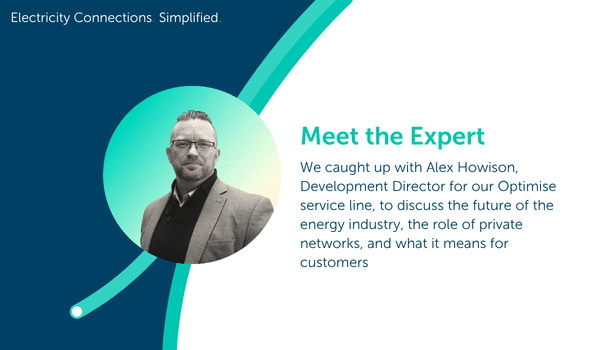
We caught up with Alex Howison, Development Director for our Microgrid and Private Networks service line, to discuss the future of the energy industry, the role of private networks and what it means for customers.
Can you tell us a bit about your career in the energy sector and what led you to join Eclipse Power?
I’ve been with Eclipse since September 2024, so it’s coming up to over 18 months now. Before I joined Eclipse, I spent two years with Low Carbon, a major global renewables developer, where I was their Senior Grid Lead, looking after a UK portfolio of solar and battery projects.
Before that, I spent 23 years with SSEN, the distribution network operator responsible for about three and a half million people across central southern England and the north of Scotland.
I worked in various roles at SSEN over that time. I started in supply, working on tariffs and sales support for general customers. I then moved into distribution emergency services and resilience, before going on to run operational depots. From there, I moved into stakeholder engagement and innovation. I finished by building and leading their flexible solutions team. It was a great career, involving some really interesting projects and giving me the chance to really cut my teeth.
My time in the energy industry actually started even earlier. In my late teens, as a college job, I worked in sales support for PowerGen, which doesn’t even exist anymore. That was weekends, evenings and days off, so technically I’ve now spent more years in the energy industry than I care to think about, one way or another.
When I left SSEN and moved into renewables development, it was a great opportunity. The Low Carbon team are brilliant and very welcoming. However, I realised that I really missed the network element and the ability to provide a service to people.
So when the opportunity came up to join Eclipse, it felt like a chance to combine the commercial, development-led experience I’d gained at Low Carbon with my long-standing experience of operating networks, running engineering teams, and delivering engineering solutions. It was an unignorable opportunity to bring together what I’d learned with what I’d realised my real passion was – the network space.
Grid connection has become a major challenge for many energy projects. What issues are customers currently facing when trying to secure connections or optimise their energy strategy?
Yes, there’s a risk that it’s a phrase that can be considered overused, but it really is a perfect storm. If you look at the connections space, what we have is energy infrastructure in the UK that is heavily regulated – and for good reason. We have some of the safest, most resilient electrical networks in the developed world.
However, there is an element of that regulation and control which may now have become a blocker. The network incumbents, and the different price control periods over the last 20 years, have not incentivised investment ahead of need or preparation for future challenges. The focus has been on efficiency and reducing costs. Unfortunately, the simplest way to reduce cost is not to spend money.
As a result, what we have in the UK is energy infrastructure that is very safe and very reliable, but still designed for a system from 25 or 30 years ago. It hasn’t evolved to meet the challenges of distributed generation in any meaningful way.
We now have really significant, high-demand loads looking to connect to the system, which presents a new challenge. The incumbents don’t move quickly enough in responding to these demands, and we still have a largely monopolistic approach to who can own, operate and develop networks. This is particularly evident at transmission level, where there are effectively three transmission owners, one system operator, and very limited space for others to get involved – at least onshore. There have been some changes offshore, but they have taken a long time to come through.
If you look at regulation, policy and government-driven change, it often takes five, ten or even fifteen years to materialise. By that point, the original challenge you were trying to solve still exists, but is now accompanied by several new ones. When you consider the electrification of heat and transport, the system is under huge pressure, yet it is still operating in a pre-2000s mindset when it comes to addressing these challenges.
It’s not changing quickly enough, it’s not sufficiently incentivised to change, and third parties with ideas that could help alleviate some of these challenges are not able to operate to their full potential. A good example of how impactful change can be is the introduction of Independent Distribution Network Operators (IDNOs). Although introduced around ten years ago, they are now often the go-to option for connections, depending on location and project type, because of the value they bring.
However, this model hasn’t yet been applied at transmission level, and there are further extensions that could be explored. Ultimately, I don’t think we, as a country – or as an industry – are moving quickly enough.
How does Eclipse Power help customers navigate these challenges and unlock opportunities?
I think Eclipse, and our funders, are very well known for pushing boundaries.
Licence-exempt networks are not a new concept, and it’s important to acknowledge that. Most major UK airports, many port facilities, MOD bases, university campuses and hospital campuses already have private electrical infrastructure operating behind a single point of connection. However, it has often been treated as something of a dark art. It’s not something that housing developers or those building smaller commercial or industrial estates would typically consider.
Bringing private, licence-exempt networks to the forefront is something we set out to do when we launched Eclipse Power Optimise. It’s about highlighting the significant opportunities available – not just in terms of cost and speed of connection, because we can build faster and more cost-effectively, while still maintaining safe and reliable networks – but also in how we approach delivery.
We can look at wider supply chains and consider safe, resilient transformers that might not meet a DNO’s specific policy or engineering requirements, but are perfectly suitable within a private network. These can reduce lead times by up to 50% and cut costs by around 30%. So, we can build faster and more efficiently.
It’s also about the ability to utilise behind-the-meter generation and storage, and to maximise the use of lower-cost energy within the system. This helps bring down energy costs for everyone connected.
An electron generated, for example, from a PV system at your home accumulates charges every step it travels through the wider network – wholesale costs, supplier levies, environmental charges. By the time that same electron reaches a neighbour’s property, its cost may have increased three or fourfold. If you can keep that energy within a private system, you avoid many of those additional charges.
That creates a significant cost benefit. Private networks can pass on those savings to connected users, while still ensuring generators receive a fair return and demand-side users benefit from lower costs.
In today’s environment – where energy prices are not only high but also highly volatile due to global events, supply disruptions or geopolitical issues – private networks and microgrids offer greater stability. They are not fully exposed to the wider system, although they remain connected to it for resilience and security of supply.
This means base demand can still be met and the lights stay on 24/7, but overall reliance on the grid is reduced. With lower reliance comes reduced pressure on the wider system, as more energy is generated and consumed locally.
For example, if a 50MW scheme is developed on the South Coast, the traditional model would require the incumbent networks to determine how to transmit that power from large-scale generation sources – such as gas or nuclear plants – potentially located far across the country. By contrast, a private network can contain and utilise that energy locally, reducing dependence on the wider grid.
There’s also a broader system benefit. By reducing the need for long-distance transmission, you avoid the requirement for hundreds of millions of pounds’ worth of new infrastructure, such as north-to-south transmission circuits. Generating and consuming energy locally simply makes sense at every level of the system.
However, because it makes sense, it also presents a challenge to incumbents whose financial models are built around the expansion and continued use of the traditional system. That may help explain some of the resistance to this type of solution.
How do you see the UK energy sector evolving in the coming years, particularly around grid capacity, renewable integration and optimisation?
I think it’s now unignorable for both the industry and government. We can’t ignore fuel prices, the rise in fuel poverty, or the pressure on the Treasury in terms of bill support. Having a safe and resilient system will always be the top priority – we must maintain a system that keeps the lights on for people as reliably as possible.
However, the pressure on cost, along with increasing scrutiny, is highlighting that the current system may no longer be fit for purpose. It worked for a centralised, non-distributed energy system, which began to decline in the 1980s and 1990s, but it doesn’t work in the same way today.
What we are likely to see is not necessarily a relaxation of policies and processes – that’s probably not the right term – but a shift to encourage and enable more innovative solutions. These may include approaches we already know can work but have previously been restricted by elements of the Electricity Act, limitations within class exemptions, or a lack of competition across different parts of the energy system.
Introducing more competition, alongside the ability to adapt policy and process, will allow more parties to participate. Whether it’s residential developers, community groups, or business organisations, there is an opportunity for them to deliver systems where energy is generated and consumed locally for 80–90% of the time.
As a result, I think we’ll see significantly more interest in and support for these types of systems, given the advantages they offer – not just to individual users, but to the wider energy system as well.
We need to encourage and support this challenge to the status quo, whether that comes from regulators, government bodies, or the government itself. The system needs to evolve, and the current incumbents need to be challenged to think more proactively, respond more quickly, and adopt a more holistic, whole-system perspective.
At the same time, that whole system must recognise that there are geographical areas seeking greater energy independence – areas that want to generate and use their own energy locally, and deliver meaningful cost savings to the people within those communities.
What piece of advice would you give someone starting out in the energy industry?
First things first – to coin a phrase from our outgoing CEO – sponge mode. Learn as much as you can. The strength of this industry is its diversity, both in terms of the work you can get involved in and the people you interact with, as well as the variety of career paths available. There’s the opportunity to specialise in a particular field, but also to gain experience across multiple areas.
Building relationships is also key. It’s quite a close-knit industry, and you tend to encounter the same people over time, so it’s important to invest in getting to know others and building relationships that will support you throughout your career. You’d be hard-pressed to find another industry with the same level of diversity in roles and opportunities.
A standard piece of advice is to value those relationships, but also never be afraid to step back and consider the bigger picture. One of the advantages I’ve had in projects I’ve been involved in is recognising that while you might solve an engineering problem by making a technical decision, that decision can impact thousands of people. For example, switching something on or off might affect three and a half thousand lives. So it’s important to think about what those people actually need.
Being able to step back and recognise that you’re part of a wider system is incredibly important. It allows you to reflect not just on what you’re doing now, but on where you might want to go next. You might become highly proficient in a specific task, but then realise you want to broaden your knowledge – perhaps into protection, switchgear, or more customer-facing roles.
As an industry, we probably don’t spend enough time highlighting just how many different career paths exist within it. There is a huge amount of opportunity, and we should do more to support each other in exploring those options.
So, keep your eyes open, work hard – that’s a given in any industry – but also be mindful of relationships and invest in them. And don’t be afraid to think about different directions you might want to take. Explore them, because this industry can almost certainly offer those opportunities.
If you could invite three people to dinner, who would they be and why?
The first one – and it’s going to sound a bit odd because of the name – is Alexander the Great… the Macedon. I’d love to understand what he was actually like as a person. He was a military genius who, by the age of 27, had built one of the largest empires the world had ever seen. It would be fascinating to see what he was like over a glass of wine.
The second would be Oliver Reed, simply because he had a big impact on me growing up. He had that quintessential English ‘bad boy’ persona, which made him incredibly compelling.
And the third would be Richard Burton. I think having those three around a dinner table would result in less food being eaten and more wine being consumed. It would certainly be an unforgettable night.