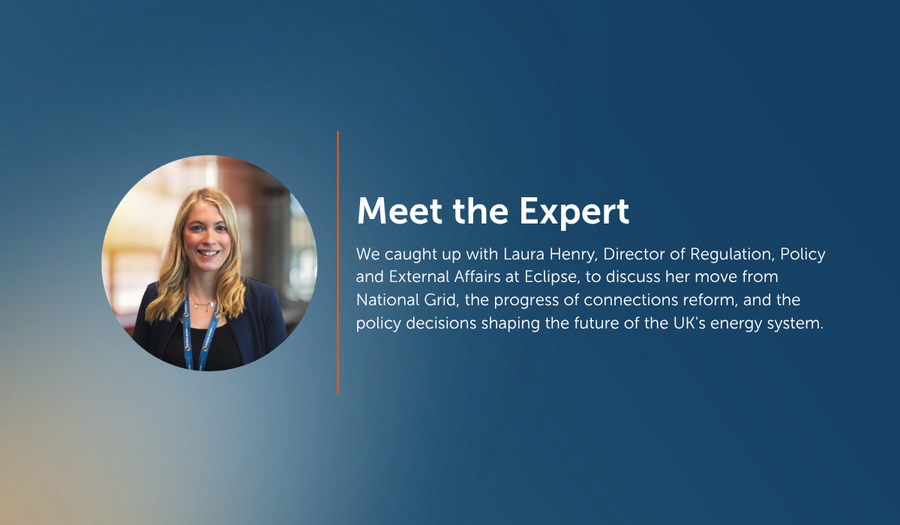
Eclipse is excited to welcome Laura Henry to the team. We wanted to discover more about her vast experience, and how her expertise will help Eclipse thrive in an exciting and challenging power landscape.
You’ve spent 14 years at National Grid, but you didn’t come into the industry as an obvious energy specialist. Can you tell us how you ended up in connections?
My background is in town planning. I got into the energy industry accidentally when I accepted a role in National Grid’s property team – I quickly fell in love with it and wanted to learn more. After a role as a town planner for National Grid I moved to the connections team to explore the energy industry. From there I’ve been heavily involved in connections reform from its earliest stages, as well as chairing the Energy Networks Association’s TM04+ workgroup to ensure distribution network operators (DNOs) and their customers had a voice in the reform process alongside transmission. I’ve also led policy teams in both the National Energy System Operator (NESO) and National Grid Electricity Distribution (NGED).
What’s your role at Eclipse, and what will be your focus over the first few months?
As director of regulation, policy and external affairs I will be focusing on Eclipse’s regulatory strategy, as well as further developing our internal and external policies to reflect the changing energy landscape.
Eclipse already has a strong voice in the industry, contributing through industry code modifications, consultations and being a member of key workgroups and forums. Part of my role is to keep building that presence, and to make sure the IDNO perspective is heard in conversations that have historically been shaped around incumbents. The closer we are to where decisions are being made, the more clearly we can communicate what’s changing to our customers, advocate on their behalf, and help them navigate the policy landscape that affects their projects.
You’re moving from one of the largest incumbents in the sector to an independent challenger. What looks different about the connections landscape from the IDNO side?
I’m excited to see the industry from a different perspective. I learnt a lot moving from the Electricity System Operator to a DNO. At Eclipse I’m looking forward to learning more about how IDNOs work, and how they benefit the connections process.
CMP376, the Five Point Plan, TM04+ – you’ve been integral to some of the most significant pieces of connections reform of the past few years. Looking back, where do you think reforms have worked, and where are they still falling short?
I don’t think that there is a single fix to changing the connections process. The Connection and Use of System Code (CUSC) process was developed 20 years ago: it will take multiple different initiatives together to make significant changes it. I’m hoping that the combination of queue management and strategic alignment, along with a newly reformed queue, will mean that we start to see a more manageable number of projects that are progressing.
AI, data centres and the wider electrification of demand are reshaping what the grid needs to deliver. From a policy and regulation point of view, where does the system most need to adapt?
As the need for demand connections is growing we need to make sure the policies and frameworks allow for simple and effective policy decisions so that projects can be connected as quickly as possible. There’s a lot of work happening at the minute in relation to demand, with the aim to ensure that both transmission and distribution projects are treated in the same way, that there’s a mechanism to prioritise and re-allocate capacity to demand projects at distribution (as there is at transmission), and that there are linkages between policy and strategic planning frameworks such as the Regional Energy Strategic Plan (RESP).
Eclipse has been vocal about the case for competition in transmission, and it applied for a transmission licence in 2022. How do you see the regulatory path to an independent transmission operator (ITO) licence playing out over the next 12 months?
It is great to see so many conversations happening in relation to ITO licensing. ITOs would serve as a critical part in delivering net zero targets, especially now that we have a pipeline out to 2035 with the new reformed queue, allowing projects to connect quicker and at lower cost. It would also help with known industry issues such as procurement wait times. With the success of IDNOs at distribution, it’s important that the same approach is applied at transmission.
What attracted you to Eclipse? What do you want to achieve in this role that you couldn’t inside National Grid?
After 14 years at National Grid it felt like the right time for a change. I wanted to experience working for a smaller but influential company – and in a part of the industry that I hadn’t had the opportunity to experience yet.
How do you switch off?
I like to spend time with my family and friends, and to exercise. It’s often hard to switch off when the landscape is changing as rapidly as it currently is: I do like to keep up to date with what’s happening, which can take up a lot of time, but it is important to have a balance of work and home life.