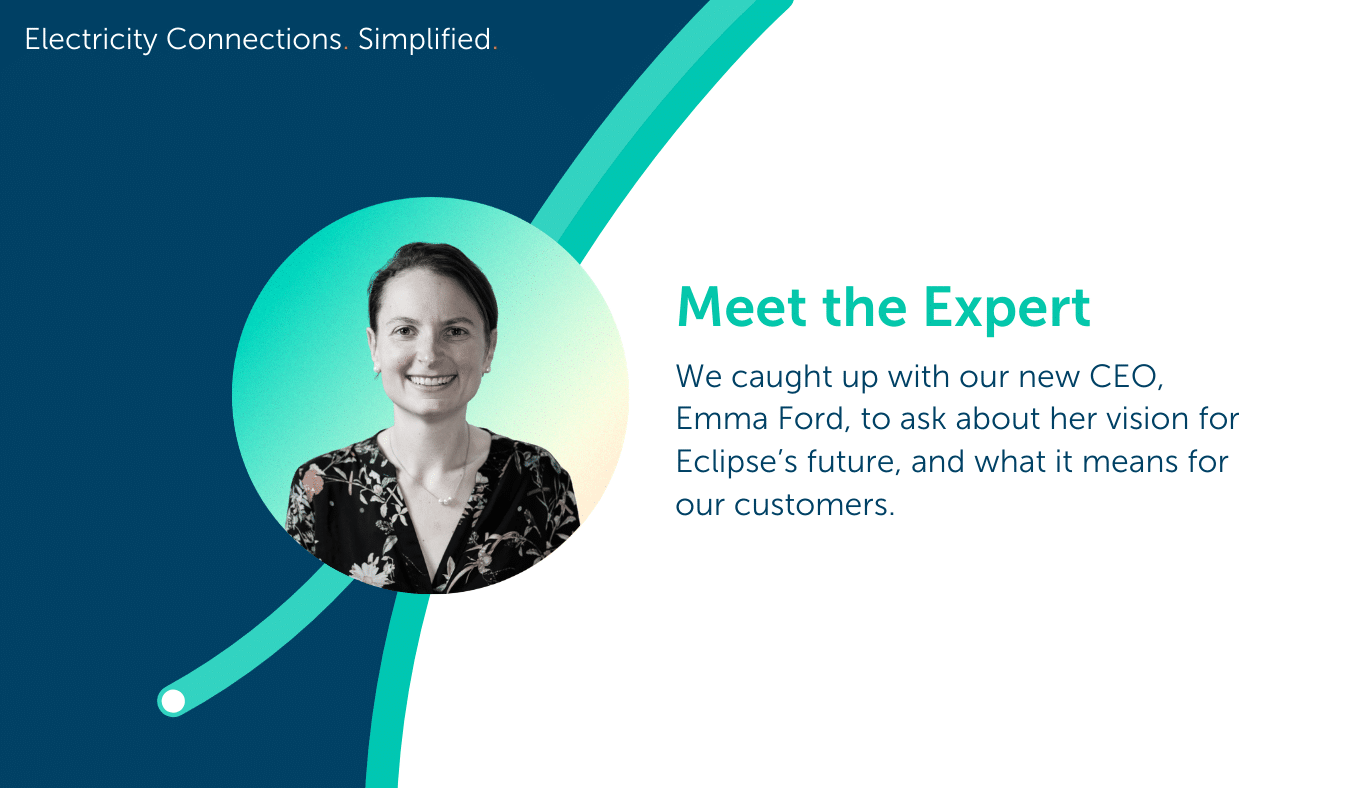
2026 will be a year of exciting changes for Eclipse, not the least of which is the appointment of our new CEO, Emma Ford. We caught up with her to ask about her vision for Eclipse’s future, and what it means for our customers.
Can you tell us a bit about your energy experience, and how you came into the UK power sector?
My energy experience has encompassed power, gas and renewables, working across what I call ‘the end to end’. I’ve led technical operations, been heavily focused on commercial strategy and customer delivery, and delivered large infrastructure projects – mainly in the electricity and onshore wind space, but I’ve also touched on offshore wind.
I’ve been involved with a complete range of stakeholders as well: generators, distribution network operators, transmission developers, and a lot of work with the regulators. I also worked in the non-regulated environment when I was at National Grid.
My passion, and the thing that drives me, is about how the UK is being powered. I fundamentally love being in a position whereby when my son switches on his lights, in some shape or form I’ve led a team that have got those electrons to that moment.
I didn’t originally set out to enter the energy industry – I almost fell into it. I was a geotechnical engineer, and I hated looking at spreadsheets and soil. An individual took a chance on me and asked if I was interested in supporting him in growing AECOM’s consultancy services for the renewables sector of onshore wind. I didn’t even know about how wind turbines worked! I had a little book called ‘How Wind Energy Works’, and I just learned on the job.
Since then I’ve had a series of senior roles through renewables, then directly for clients, moving from consultancy to client side. Then I moved through the different parts of origination, investment, development, construction, and then operations, before I left and went into offshore operations for Ørsted.
What’s your role at Eclipse Power, and what will you be doing day to day?
I’m CEO, responsible for taking Eclipse Power Group through the next phase of its strategic growth. This was a family business that then grew when Octopus became a key investor, and eventually owner. My role is about moving Eclipse to a position of being medium scale, growing its UK presence, and looking at avenues for potential further growth.
I want the Eclipse Power Group brand to retain its exceptional engineering and operational excellence as it grows. Fundamentally, that means retaining our core expertise and customer service – the things that mark us out – as we move through strategic growth and become a more sizeable company.
It’s about driving the flexibility for our customers, and providing the service that they need. It’s about being in a position where when a large industrial unit comes along and says it needs to be connected; we’ve got the solution. If it’s renewables, we’ve got the solution.
I want our customers to experience that simple, solutions-focused customer journey.
Our recent acquisition of Vattenfall Networks demonstrates how acquisitions in the independent distribution network operator (IDNO) space can be successful. Eclipse and Vattenfall Networks learn from each other, draw on each others’ expertise, and together provide greater customer service.
As a growing business, I want to utilise partnerships with developers of battery storage, data centre and other large power projects. I want to ensure we’re positioned so we will have a part to play from the moment an offshore wind farm connects to the grid, all the way through to that electron moving to someone’s home. That’s when I believe that we’ve achieved something great.
What are the challenges facing Eclipse’s customers across generation and demand? And what are the opportunities? How will Eclipse help?
I break it down into five different challenges. The first is grid capacity. There are renewables projects, battery storage, industrial electrification and EV infrastructure projects that want to connect, but there isn’t the capacity to do it.
The second is the grid connections queue – and that really is slowing down housing, commercial and strategic infrastructure projects. Developers are concerned, as are investors, because they don’t know when they’re going to get their own returns.
The other challenge is aging infrastructure on the network. When we look at using it to help decarbonise transportation and for the electrification of heat, there’s a massive need to think differently about how electrons will move across the network.
Also, there’s the continuing need for regulatory and policy change. Then the final piece is uncertainty for developers around their timelines, but also regarding CapEx requirements.
I love a good challenge, because they also bring opportunities. Everything is solvable within the electricity network space – you just need the right people in the room to have the dialogue, think differently, and try to find that innovative solution.
This is where Eclipse excels because of our footprint, engineering capabilities, and our financial foundation – something that not all IDNOs can call on. Eclipse can bring capacity opportunities, consistency and confidence at the time when the sector most needs it. I also plan for us to have a more focused, proactive involvement with the regulatory space, and to be influential at the top table.
What makes Eclipse different, and how do you aim to make it even better?
The thing that really drove me to join Eclipse was that its values reflect those of its people. We’re a very personality-driven business. That resonates massively with me: being friendly experts, being collaborative solution finders, having the flexibility and curiosity – and always thinking, is there a better way?
From these stems our drive to be relentlessly innovative. We’re not innovators in the sense that we’re necessarily rolling out new technologies and new software. How we innovate is in finding a better way to achieve success and solutions for our customers.
My focus will be to strengthen and expand Eclipse’s advantages and truly be a partner for developers, generators, and all organisations that want that future-proof power solution.
Eclipse has a reputation for thinking big. Can you share any exciting plans or projects on the horizon?
We’re an ambitious business and have exciting developments that I’m looking forward to delivering. Unfortunately, it’s a highly competitive space, so this isn’t yet the time to talk about them.
But we do have two big opportunities. The first is for us to really expand our consultancy arm. We have so much knowledge and experience; we should maximise how we use that to help others.
The second is in helping connect and energise large-scale infrastructure: the data centres, ports and hydrogen-ready assets. We have a great opportunity for partnership in that space, getting those facilities the private networks they need.
AI is changing many industries, and even damaging employment prospects in some fields. Is the power industry still a good career for school leavers and other young workers?
AI, I think, has a role to play to simplify complexity in a historically ageing industry. There is always a place for engineering expertise, but AI offers opportunities both for helping explain to customers the root cause of an issue, and for improving checks and balances within asset management – a big part of an IDNO’s role. But AI does not replace human thought. And it can’t innovate, because fundamentally it’s only as good as the data it’s been trained on.
Our industry is expanding, and it’s short of talent and resources. As we move towards net zero, there is a need for continued career investment in engineering, project delivery and operational expertise, but also in the digital capabilities to use AI to its full potential.
This is where my passion also sits: Eclipse has a graduate scheme, and we’re investing in the future generation. It’s about supporting that next generation on long-term pathways that will let them create a meaningful impact. But we shouldn’t focus exclusively on youth; we need to get the amazing expertise of all generations into play. We want to support not just school leavers, but those who are changing career or taking a different path.
What do you like to do to relax?
I’m not great at it! For me it’s about spending time with the family. I love exploring new places, and my dog requires a lot of walking.
I also teach children to swim. Not every child has the opportunity to learn to swim, but for me it’s a core skill that individuals should have. So on a Friday night I get into a pool, then I do one-to-one and group teaching, and it’s the most amazing detox from a week.
I enjoy getting into a different way of thinking, but it also resonates massively with who I am as a leader. Everyone has something special. You just need to find that unique way to work with them, to support them to bring their best to whatever they’re doing.