How the National Grid works

The following graphics explain how the national grid works and the different parts of the UK electricity grid at each level from generation through to demand. The full diagram is available at the bottom of the page.

National Grid power sources

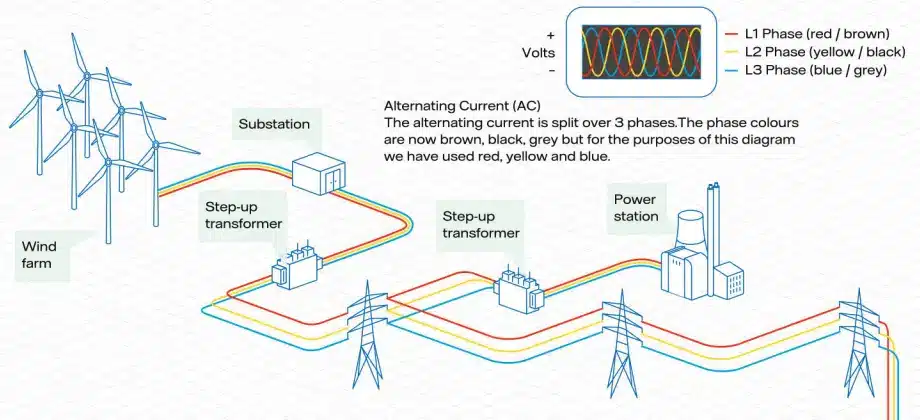
Electricity is generally generated and fed into the National grid in alternating current (AC), typically at 275 or 400 kilovolts (kV), via step-up transformers.

In the UK our electricity comes from a range of sources and the exact mix varies on a daily basis. The main sources are gas fired power stations, wind turbines, nuclear power stations, biomass, coal, solar, imports, hydro and storage. See monthly reports of the UK energy mix.

National transmission network

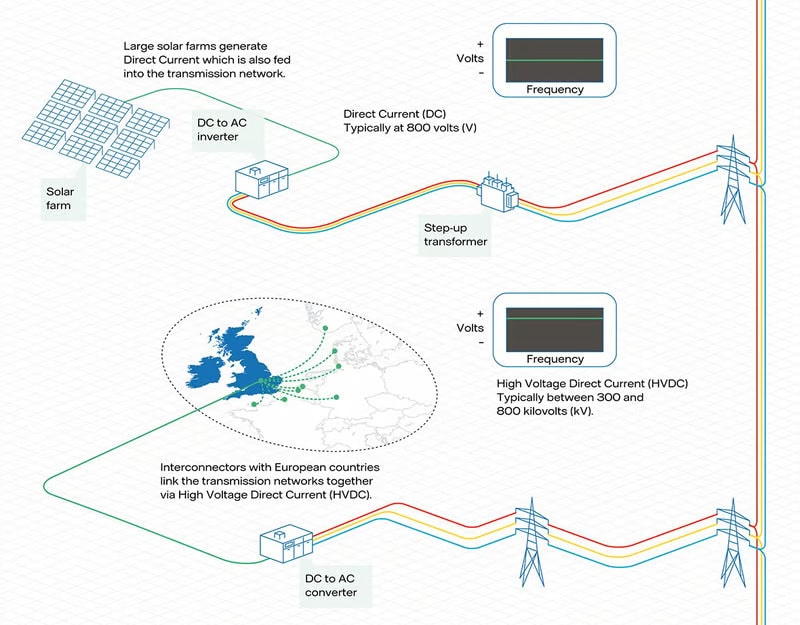
The national transmission network operates at extra high voltages (EHV) of 275 or 400 kilovolts (kV) and is managed by National Grid. Large solar farms generate Direct Current which is also fed into the national transmission network. Interconnectors with European countries link the transmission networks together via High Voltage Direct Current (HVDC).

How the National Grid works - Transmission

Distribution networks

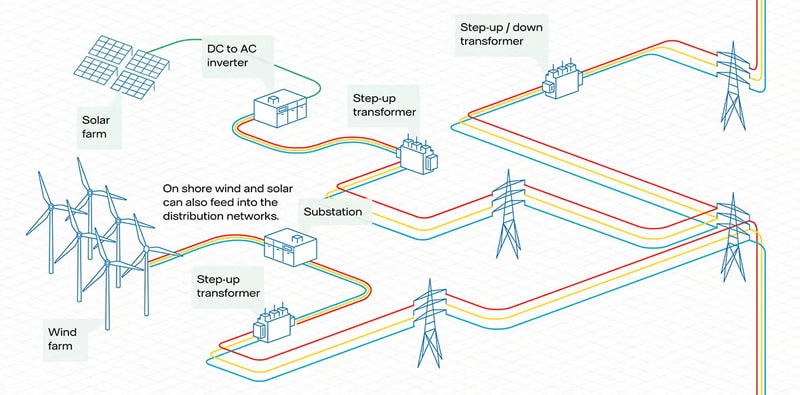
The UK’s distribution networks operate at High Voltage (HV), typically with distribution voltages of 11, 33 or 132 kilovolts (kV). Distribution networks are managed by Distribution Network Operators (DNOs) and Independent Distribution Network Operators (IDNOs).

How the National Grid works - Distribution

National Energy System Operator

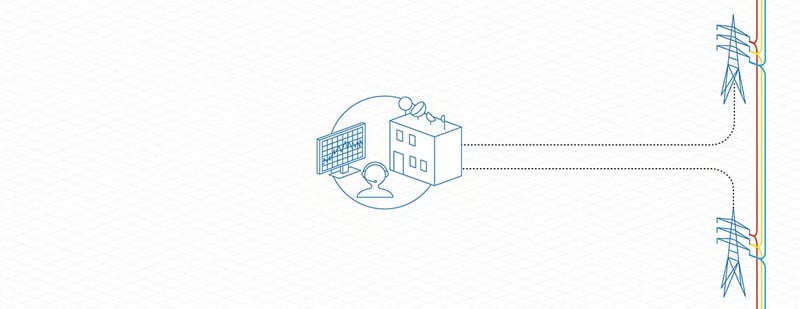
The National Energy System Operator (NESO) balances supply and demand. They operate the system but are not responsible for the infrastructure.

How the National Grid works - national energy system operator

Private wire networks

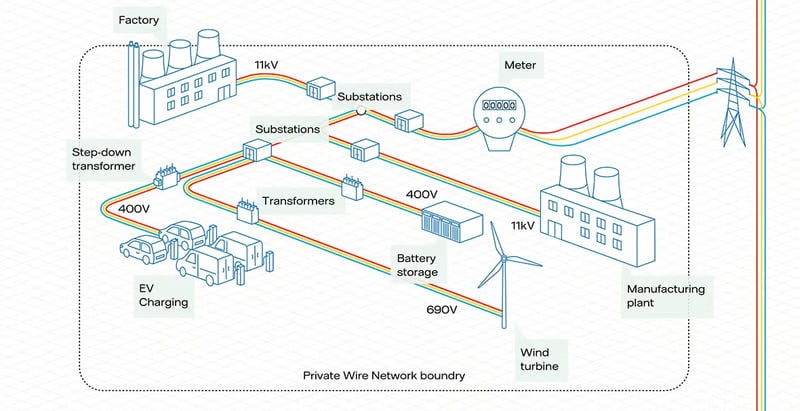
Private wire electricity networks are company-owned and distribute electricity around a site behind / below the meter. Large industrial / commercial premises generally receive 11 kilovolts (kV).
How the National Grid works - Private Wire Networks

Consumer demand

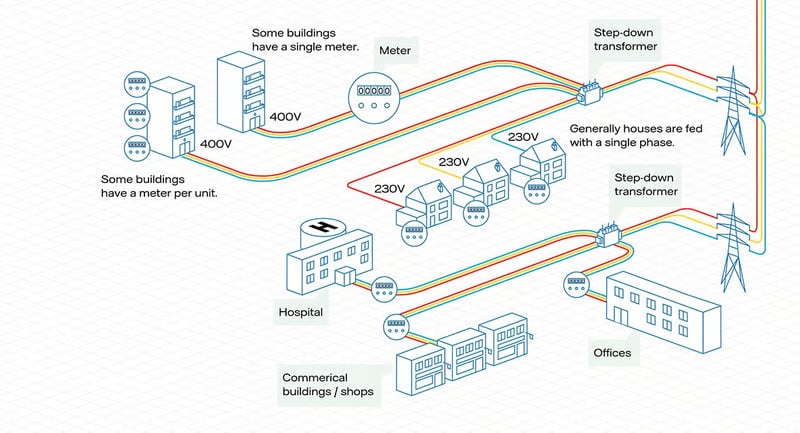
Electricity is generally consumed at Low Voltages (LV) between 400 and 230 volts (V).
How the National Grid works - Consumer demand

Download

Download a PDF of the full infographic explaining how the National Grid works.